

Obesity
What Are the Medical Risks of Obesity?
What Are the Health Risks of Obesity?
Obesity is the most common epidemic of the modern world. According to the data, nearly 40% of the U.S. population suffers from obesity, with projections indicating that in 15 years, half the population will be affected by severe obesity.
What about Israel? According to data from the National Institute for Health Policy Research, approximately 62% of men and 55% of women aged 20-64 are overweight or obese. This trend is increasing by an average of 5% per year more than the annual population growth rate.
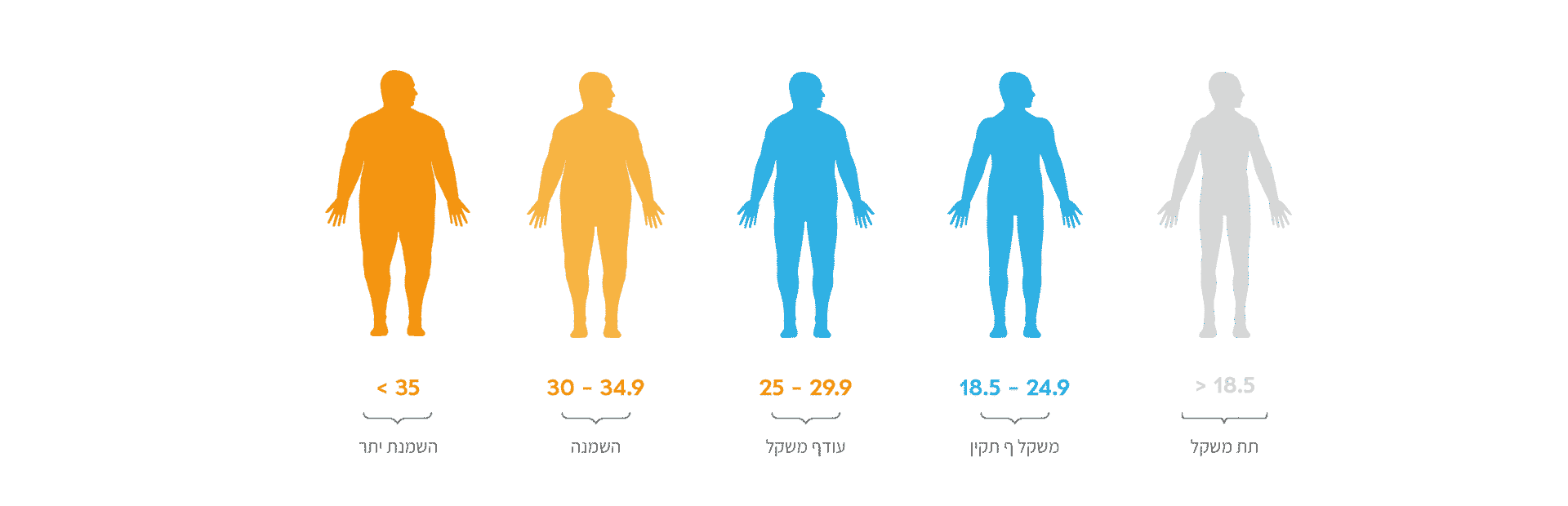
And what is the definition of obesity? Excess weight is measured by our BMI, or Body Mass Index, which assesses the ratio between height and weight and is calculated as follows: our weight (in kilograms) divided by height (in meters) squared.
The resulting number is the BMI value, where a value between 18.5–25 is considered normal, 25–30 is classified as overweight, a result above 30 indicates obesity, and over 40 is defined as morbid obesity.

The problem has not skipped over Israel either:
Of the adult population in Israel
suffers from obesity
Among those suffering from obesity, many also suffer from related conditions – diabetes, high blood pressure, heart disease, cancer, and more.
People die every year in Israel as a result of obesity-related diseases.
Is It Really That Dangerous?
Absolutely. Obesity is a major risk factor for numerous diseases and is the fifth leading cause of death worldwide. Morbid obesity is considered as harmful to health as smoking.
Various studies have shown that men and women suffering from obesity lose an average of 8 healthy years of life and tend to develop illnesses at a younger age compared to individuals with a normal weight. Diseases associated with obesity include diabetes, sleep apnea, and fatty liver.
Many of the body’s organ systems are affected by excess weight, either due to physical strain or disruptions in metabolic processes. Obesity-related diseases can be categorized into two main types: biomechanical (affecting the body’s physical systems) and metabolic (affecting the body’s chemical processes).
Biomechanical stress from obesity can lead to a range of physical issues such as arthritis, lower back pain, plantar fasciitis, hernias, and varicose veins. Ongoing wear on the knees and joints from carrying excess body weight may result in cartilage tears and the need for joint replacement.
Sleep apnea is very common among individuals with severe obesity, mainly due to the physical pressure exerted by excess weight on the chest and diaphragm, causing tissue collapse in the neck during sleep.
Today, medicine recognizes that fat tissue affects the endocrine system, which is responsible for hormone secretion, and in turn, influences the immune system. When fat cells grow beyond their normal size, the body begins to store fat energy in unnatural locations, such as the liver and especially around the waist.
This process is known as “adiposopathy” or “sick fat,” and when it occurs, it can lead to metabolic diseases like diabetes, along with elevated blood pressure and increased cholesterol levels.
Although these are the most common diseases associated with obesity, there is also a heightened risk for many other conditions such as gallbladder inflammation, polycystic ovary syndrome, cataracts, and various types of cancer -including breast, prostate, colorectal, and esophageal cancer.
A recent study published in the medical journal *JAMA Oncology* found a clear connection between obesity in women and early onset of colorectal cancer. According to the study, women suffering from obesity are twice as likely to develop the disease.
And that’s without even addressing the psychological and emotional aspects. Obesity has far-reaching mental and social consequences. Our society still struggles with “fatphobia,” and people, especially children, often show very little tolerance toward significant excess weight.
Overweight children frequently endure social bullying, ridicule, and name-calling, which often lead to low self-esteem unjustly so. In many cases, this diminished self-worth becomes deeply rooted and continues into adulthood, fueling a vicious cycle of emotional eating and further weight gain.
In addition to all this, obesity also causes functional impairments. People with excess weight often find it harder to move, bend, and stay mobile, and they frequently suffer from excessive sweating due to the added weight. These challenges highlight the critical importance of initiating obesity treatment in the early stages before related diseases begin to develop.
What's the Problem? Just Eat Less...
Until the 1990s, obesity was considered entirely a behavioral issue. If you were overweight, the blame was placed on you on your lack of self-control, on momentary cravings that sent you to the fridge at 2 a.m. Even today, many still believe that if you’re overweight, all you need to do is simply stop eating so much. Sounds simple, right?
Not really. Around twenty years ago, leading doctors in the U.S. began to change this mindset. As weight gain continued to rise across the Western world, experts started to recognize that this isn’t a trivial problem. Obesity has multiple causes genetics, the over-industrialization of food, and modern lifestyles that keep us sitting for long hours at work, leading to less physical activity.
On top of that are the emotional and psychological aspects that often go untreated. These elements contribute to an endless loop of diets and weight gain. Research shows that between 65% and 95% of people who lose weight end up gaining it back, now with added frustration and feelings of failure.
While we try to manage excess weight through many approaches, from strict diets to bariatric surgery when necessary, a major shift happened in 2013. That year, the American Medical Association officially recognized obesity as a disease that requires medical care.
Today, we have a much better understanding of the brain mechanisms that control hunger and fullness. It’s now known that one of the main causes of obesity is a disruption in the body’s ability to regulate these signals. This often makes medical intervention through obesity treatment necessary to address the condition effectively.
Obesity - How Do You Break the Cycle?
In recent years, there has been a significant breakthrough in the treatment of obesity. With a deeper understanding of how the body’s hunger and satiety mechanisms work, health authorities in Israel and worldwide have approved several effective medications for weight loss. These drugs were originally intended for treating diabetes and managing blood sugar levels, but studies have shown that at higher doses, they help promote controlled and effective weight loss.
It is important to clarify that these medications are not a miracle. They are not simply a prescription for pills or weight loss injections that instantly solve the problem. Weight loss medication must be part of a comprehensive treatment plan that includes nutritional adjustments, medical supervision, monitoring of side effects, and changes in lifestyle habits. Any other type of treatment is likely to fail and may even lead to health risks.
The effectiveness of weight loss injections and other medications varies from one to another, as do the side effects. That is why obesity treatment should be tailored personally for each patient. After a proper diagnosis and based on the patient’s medical history, the physician can recommend the most suitable medication as part of a full personalized plan, both medical and nutritional.
Studies conducted in recent years have shown that obesity treatment provided by a professional multidisciplinary team is especially effective, both for achieving balanced weight loss and for maintaining long-term results. Today, only a limited number of centers and clinics worldwide offer multidisciplinary obesity care teams who provide ongoing medical and nutritional support. It is highly recommended to carefully choose an experienced center with proven results.
What Medications Are Currently Available for Obesity?
As the field of medication-based obesity care has grown along with demand, more and more drugs have been developed to support weight loss.
There is a wide range of medications for obesity treatment, with some targeting the brain’s hunger and satiety mechanisms, while others work by breaking down dietary fat in the stomach. Some are intended for long-term use, while others are prescribed for limited periods. Certain medications come in capsule form for weight loss, while others are available as weight loss injections. Their effectiveness and side effects vary from one medication to another.
This wide selection also allows for drug combinations that enhance treatment effectiveness and reduce side effects-provided they are prescribed under the supervision of a physician experienced in obesity care. The treatment protocol is customized for each individual after assessing their medical history, including regular medications and the underlying cause of their weight issues.
One of the main advantages of prescription medications approved by the FDA and the Israeli Ministry of Health is that they not only promote weight loss, but also help patients maintain their new weight over time.
When a patient significantly reduces their weight through medication and is no longer constantly thinking about food, they are able to begin a comprehensive, multidisciplinary program that supports gradual, controlled weight loss while the body gradually adjusts to lower medication dosages. This treatment approach also helps maintain weight loss and prevents rebound weight gain.
Today, there is a deeper understanding of the brain mechanisms responsible for satiety, and it is now known that one of the main issues leading to obesity is an imbalance between the body’s hunger and fullness signals, which requires medical intervention to treat the condition.
Am I a Candidate for Medication-Based Obesity Treatment?
To determine whether you’re a candidate for weight loss medication, you’ll need to calculate your body’s BMI using the formula mentioned above. If your BMI result is over 30, or over 27 accompanied by an additional risk factor related to severe obesity, you may qualify for weight loss medication with special approval from the Ministry of Health.
Medication-based obesity treatment at a medical center that applies a multidisciplinary, medically supervised approach could be your first step toward a healthier, renewed life.
BMI Classification Table
Questions and Answers
What Is the Definition of Obesity?
Excess weight is measured by our BMI, calculated by dividing our weight by the square of our height. A result over 30 is classified as obesity.
What Is the Risk of Obesity?
Obesity is a risk factor for diabetes, cardiovascular diseases, high blood pressure, various types of cancer, joint problems, and more.
How Many Weight Loss Medications Are There?
There are over 10 weight loss medications available, with the most effective treatment involving combinations of drugs and varying dosages tailored to the patient’s specific condition.
Who Is a Candidate for Medication-Based Obesity Treatment?
Medication-based obesity treatment is intended for individuals with a BMI over 30, or over 27 with an additional risk factor related to obesity. The medication can be prescribed following special approval from the Ministry of Health.
How Do You Receive Medication-Based Obesity Treatment?
To lose weight with the help of medication, it is recommended to visit a medical center experienced in medication-based obesity treatment as part of a multidisciplinary program. This includes medical supervision, drug combinations, side effect monitoring, nutritional adjustments, and lifestyle changes.